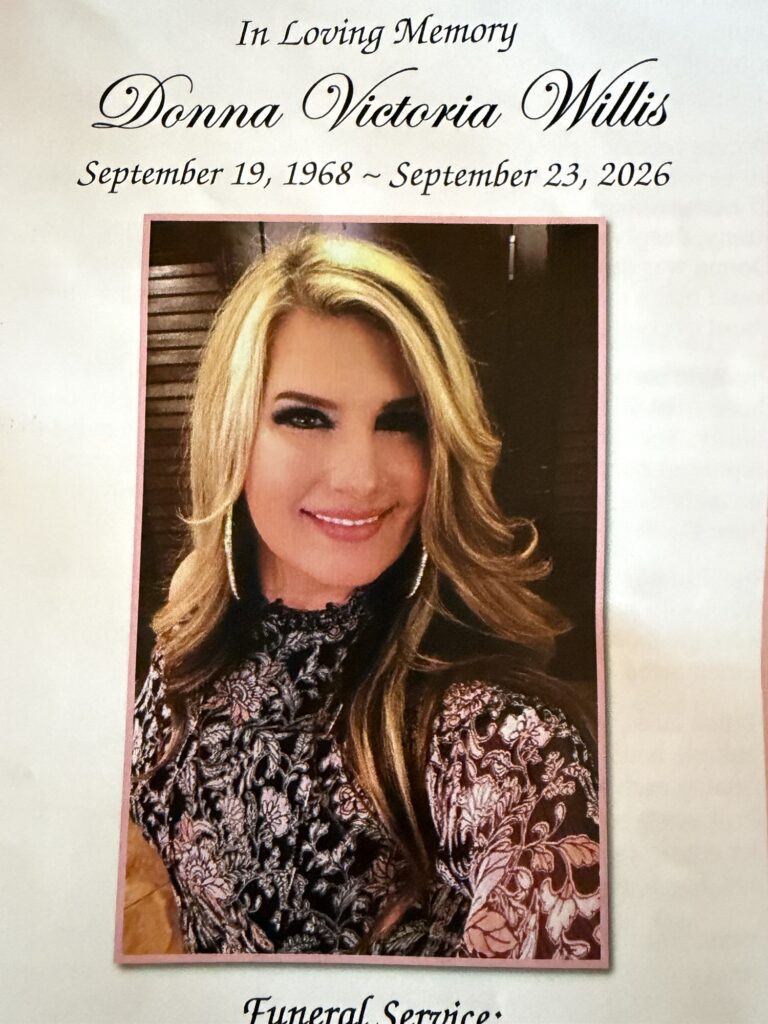
It was time for the family to go back for the viewing, but we were waiting on someone else. The funeral home asked if anyone wanted to go back alone.
I said I would.
I wasn’t prepared for what happened when I saw you in that coffin, Mom.
It felt like the nightmare you hope you’ll wake up from before it actually happens.
I knew you were dead.
I knew it.
But some part of me still believed that if I could just say the right thing, loudly enough, desperately enough, you might open your eyes.
I think I thought that even if you didn’t open your eyes, something in me could shift and I could find closure.
But each time I said it all, nothing changed in me, so then I would scream it all again.
And nothing was changing in front me or inside of me.
You looked like you.
You weren’t deformed. You didn’t look terribly sick. You hardly looked dead.
I looked at you and thought:
How could I have known?
And then I lost it.
“Mom, I love you.”
“I’m so sorry.”
“I want my mom.”
“Everything is my fault.”
“Mom, I’m so sorry. Please forgive me.”
I screamed it louder.
And louder.
As though volume might somehow reach wherever you had gone.
The last thing I said to you while you were alive was that I loved you. I’m grateful for that.
But standing there looking at you, I wished I had said it in person.
I wished I had hugged you.
I wished I had kissed your cheek.
I wished for one more chance to make everything between us small enough that love could swallow it whole.
Mom, I am dying inside.
You didn’t wake up.
I tried so hard.
Eventually I stopped looking at the coffin and started looking at you.
The little freckles on your hands.
The bump on your nose.
Your fingers.
They looked exactly the same.
There was something strangely comforting about being close to you. I had spent days dreading that room, and suddenly I didn’t want to leave it.
Mom, there is a hole where you were.
When crying and screaming didn’t work, I got angry.
I wanted to punch the wall.
I wanted to throw something.
I’m getting angry again writing this.
I know you didn’t choose to leave me, Mom.
Of course I know that.
But my broken heart doesn’t care what my brain knows.
I was furious that you left me.
I was furious because you knew how much I loved you.
I spent so much of my life wanting to be a good daughter and wanting you to be proud of me.
And I needed you.
Sometimes I don’t think you understood what I needed because you spent so much of your own life surviving.
You grew up worrying about things I never had to worry about.
But I was fed, Mom.
You made sure of that.
You gave me a different life.
And because you did, my needs became different from yours.
Sometimes what I needed couldn’t be bought.
It couldn’t be fixed.
It couldn’t be put in a box or handed to me.
And sometimes we completely missed each other there.
But there were other times when somehow you knew exactly what I needed.
There were days when I called you because I was emotionally on the brink.
There were days when I was haunted and couldn’t get off the floor of my office because my body felt too heavy for my heart to carry.
And somehow, Mom, you could put your hand right through that phone and hold me.
You carried me.
That’s part of why I’m so angry now.
Because I still need you.
And you’re gone.
I feel like I’m screaming inside a heart stuck somewhere between what was and what can never be again.
I know I will never be exactly the same.
And then, while I was standing there screaming at you, I realized something.
It was the first time in my entire life I had ever spoken to you and you didn’t respond.
So I screamed until I couldn’t scream anymore.
And then I stayed.
I had thought I would want to run from your funeral.
That’s what I do with pain sometimes. I retreat. I don’t particularly like being held. I don’t like being watched while I hurt. Give me a room by myself and let me figure out how to breathe again.
But I couldn’t stay away from you.
After I wore myself out, I stayed close.
I looked at your freckles on your hands.
Your face.
The way your nose had that bump I wish mine had.
All those tiny features that belonged to my mother.
And eventually I thought:
You’re not hurting anymore, Mom.
You carried wounds long before I ever existed. Some of them followed you through your entire life.
Some reached me, too.
There were things between us that I desperately wish had been different. There were things I needed from you that you couldn’t always understand. There were things you needed from me that I couldn’t always give without losing pieces of myself.
We hurt each other.
We loved each other.
Both things are true.
And death doesn’t sanitize the past.
And the past doesn’t have to be rewritten for me to miss you.
I don’t need to erase the hard parts to know that I would move heaven and earth today to have you back.
At your funeral, people talked about how much you helped people.
How compassionate you were.
How you could see someone hurting and immediately want to do something about it.
They were right.
That was you.
But compassion was complicated in our family.
Sometimes you could understand the wounds inside people who had caused wounds of their own. Sometimes I needed you to understand mine, but I couldn’t ever tell you outright.
I don’t think we ever completely figured that out.
Maybe we would have.
I thought we had time.
Goodness, Mom.
I thought we had time.
And there are things I wish I could tell you now.
I understand more about you than I did when I was younger.
I understand that you were mothering me with tools you had forged while surviving your own childhood.
I understand that some of the things you gave me were things nobody had given you.
And I understand that some of the things I needed were things nobody had ever taught you how to give.
None of that makes every hurt disappear.
But it makes me look at you differently.
And now there is Abigail.
Your granddaughter.
There are things that hurt you.
There are things that hurt me.
But they don’t get her.
That’s where this story changes.
She doesn’t have to inherit every wound simply because it came before her.
And, Mom, I wish you had understood that sometimes when I created distance, I wasn’t trying to stop loving you.
I was trying to stop pain from traveling another generation.
I couldn’t save the little girl you were.
I couldn’t save the little girl I was.
But I can protect mine.
And I’m going to give her the good parts of you.
There were so many.
Your generosity.
Your toughness.
Your ridiculous determination.
Your humor.
Your ability to make a catastrophe somehow seem manageable.
Your willingness to show up.
Your fierce love.
The way you could make me believe everything might actually be okay when I called you from the floor.
The way you came from so little and made sure your children had more.
Those things get to keep going.
Maybe that’s how families heal.
Not because one generation suddenly gets everything right.
Maybe one mother changes what she knows how to change.
Then her daughter changes a little more.
And someday my daughter will probably recognize things in me that I couldn’t see myself.
Maybe she’ll change those too.
One daughter at a time.
I may spend the rest of my life walking across some of the broken glass left behind.
But I’ll put my daughter on my shoulders.
She doesn’t have to walk through it just because we did.
And you don’t have to walk through any of it anymore either, Mom.
You’re free.
Nothing that haunted you can reach you now.
And that space between us that felt so enormous at the end?
It’s gone.
None of it matters to me standing beside your coffin.
I would move heaven and earth to hug you.
I’d kiss you on the cheek.
I’d tell you I’m sorry.
I’d ask you to forgive me.
I’d tell you I forgive you.
And then I’d probably hold onto you until you complained that I was squeezing too hard.
But I can’t.
And maybe that was what all that screaming was about.
For the first time in our relationship, there was nothing left I could say that could change what happened next.
You didn’t answer.
You couldn’t.
So eventually I stopped trying to find the words that would bring you back.
Those are incredibly ordinary things, but nothing feels ordinary right now.
I think if anything can distract me from the pain, it’s showing up like a mom. There is something about sitting beside my children and doing the things I’ve always done that gives my brain somewhere else to go for a little while.
Maybe that’s part of how I will get through this.
By still being their mom while I figure out how to live without mine.
Mom, I don’t want to go to your funeral.
It’s not that I don’t love you. I love you enough to go to your funeral.
It’s just that I don’t grieve this way.
I don’t grieve with people.
And I know that frustrated the hell out of you sometimes. You would call when I was falling apart, and somehow, even with you, I was unwilling to completely unravel.
But I think eventually you figured out that this is just who I am.
I don’t know how to talk when I’m overwhelmed. I only know how to go silent.
I’m so extroverted and outgoing that I think it’s easy for people to take that personally. But the bigger the feeling, the quieter I seem to become.
I talked to Bryan. He told me I’m all he has left in this world.
I don’t think that’s true.
But since losing you, I’ve caught myself thinking almost the opposite: maybe the fewer people I have, the better.
Because even through our trials, Mom—even during the times when we frustrated the absolute hell out of each other—I knew you loved me.
And you knew I loved you.
Losing someone I loved this much hurts badly enough.
I wonder sometimes if I’ll ever have the energy to explore the world the way I did before you died.
Because when life went sideways, I called you.
And you would just handle it.
Sometimes callously. 😂
But you handled it.
Or, when you couldn’t, you told me exactly how I should handle it.
And now that you’re not here, I’m scared.
I’m not scared of living day to day. I’m not afraid that I can’t take care of myself or my family.
I’m scared that my backbone is gone.
We were opposites, and I think that’s one of the reasons we worked so well in a lot of ways. It’s probably also why we had so much conflict.
But I think being different from each other was part of what made our relationship uniquely close.
You were everything I am not.
You were decisive.
Painfully unwilling to tolerate disloyalty.
You weren’t afraid to ask the question that might offend someone.
You were really good at controlling how much of your vulnerability you gave away.
You knew when it was time to pull back from someone. You knew how to limit the amount of control and space that person was allowed to take up in your mind.
You were callous in all the right ways.
Not mean.
You just didn’t put up with shit.
And then there was me.
I was your feeler child.
The one who felt everything.
The one who trusted everyone.
I was your calm.
But I was also the one who wasn’t afraid to leave the nest. I wasn’t afraid to go experience life on my own, even when it hurt you.
And you always told me that you loved that about me.
You told me it hurt that I never really needed to come home physically.
I always called home.
But I didn’t need to come home.
And you told me that was also a relief, because you knew that when this day eventually came, I would be okay.
And Mom, I am okay.
Or maybe okay isn’t the right word yet.
I’m grieving. I’m hurting. But right now my grief seems to have boundaries.
I’m still sleeping at night.
Not because I didn’t love you.
God, I loved the heck out of you.
I think I’m sleeping because some part of me understands that you’re not in pain. And another part understands something I really don’t want to understand yet:
You’re not here.
And I’ve got to figure out how to be the best version of myself now without you.
I can’t call you and sit on the phone for eight hours.
I can’t plot revenge with you.
I can’t laugh with you.
God, you were funny.
I remember one time your neighbor pissed you off. She had cancer, and you said that if you ever went terminal, she’d better watch out.
It was a joke.
But it was funny as hell.
And strangely, I always dreaded the possibility that you would go terminal, because then I would know I was losing you.
I imagined there would be a warning.
There would be time.
There would be things we would say.
But you never went terminal.
You were just here.
And then you weren’t.
Which, I suppose, is at least good news for your hit list.
It’s been three days since you died, Mom. I am still in shock, but I think it’s wearing off a little.
The weather is beautiful, and I sit outside to be closer to you. The walls in my house feel like a barrier between us.
Everyone thinks you may have known. Why didn’t you tell me?
Mom, if you ever thought I would be okay, you’re wrong.
I know the way you supported my siblings felt tangible to you, but the way you were there for me was irreplaceable. The laughter, the intuitive way you could read right through me, the secrets, the safety, the prodigal’s mom that you were.
I always knew that I could call. And damn, even when you warned me not to make the same mistake, I would be forced to call you again and tell you I didn’t listen.
Mom, you are the reason I became who I am. I am strong and independent because I watched you.
I witnessed you beat cancer when I was nine.
I watched you turn poverty into gold.
I watched you not lose a wink of sleep over what people thought.
I watched you fight battles for me.
And when I got older, and I was in a tough spot, and you knew my tender heart could not bear the thought of doing what needed to be done, you told me exactly what to do and what to say.
A lot of people needed to die to me, but I couldn’t do it.
I always had you there to walk me through it.
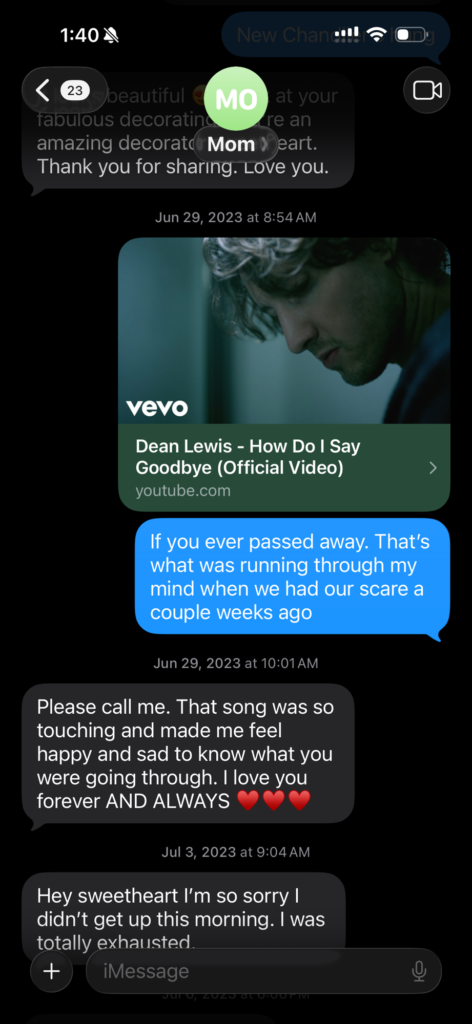
Yesterday, I found a text exchange between us from when you had a biopsy done at your mastectomy site.
I sent you a song I had heard on the radio that articulated my fear of losing you better than I ever could.
Today, I am living that song.
But at least I’m living it knowing that I told you how this would wreck me.
I am not convinced that you can see me. I don’t think heaven works like that.
Today is a little over 48 hours since you took your last breath. For the first 48 hours, I cried every waking minute for you. It’s the first time I cried out loud, and you didn’t come.
The pain of realizing you’re gone feels unbearable. I close my eyes and imagine what your last breath was like. I want to know so badly, Mom. Did you know you were dying?
Phillip told me that you shared a story with him a week before you died about an out-of-body experience. You said you were floating over your own body in the clouds, and there was no pain. You said it was wonderful.
Mom, did you know you were dying? Gosh. If you did, why didn’t you tell me? Did some part of you know it was coming? Did that experience make you less afraid to go?
I am angry.
I have a voicemail from you where you said you love me. I saved it. I want to hear your voice; I don’t think I can. It won’t soothe me anymore. It will make me long for you and remember I can’t have you, and my heart will bleed.
I keep a notebook with me now. I write to you all day. Then I get angry while I write because I know you’ll never see it.
You are gone.
You went somewhere I can’t go, and I didn’t get to say goodbye.
I am hurting so loudly, I hope you can hear me in heaven.
That seems like an important detail to establish before I explain how Robert and I somehow ended up spending Friday night working opposite sides of a high school football field.
A while back, I saw a post looking for parents to help around football, and since Matthew is playing junior high this year, I immediately thought, Robert would probably love doing chains. He could be right there near the field and feel a little more involved.
I almost tagged him and put his name down.
Then I stopped myself.
Because obviously you’re supposed to ask your husband before volunteering him for things. Or so they say. 😂
I thought, I’ll ask him later.
And then, naturally, I forgot.
So imagine my concern when Robert was out of town and he sent a text saying, “I keep getting messages asking if I’ll do chains for the high school game. I don’t even know how they got my name.”
Uh-oh…
I was driving down the road thinking:
Did I do that?
Did I accidentally hit send on the comment thread?
Am I really this tired?
Surely, I did not do that.
Turns out, I was innocent.
Robert had independently signed himself up to help with junior high chains — something I didn’t even know he had done — and when they needed someone for the high school game, they asked him too.
So, for the record:
I did not volunteer Robert. Robert volunteered Robert.
And apparently he did a pretty good job, because two days later (today) they texted him asking if he would work high school chains every week.
He now has a chains T-shirt.
This escalated quickly. 😂
And Somehow I Ended Up on the Other Sideline
When Robert first asked whether I cared if he worked the game, he told me he could really go either way.
It just so happened that I already needed to meet the athletic director and pick up my photography credentials, so I told him, “You know what? Go ahead. I may just stay and practice. If I get run over in front of the high school parents, guess what… I won’t have to see those parents again.”
And that is how we packed up the family and headed to a high school football game where absolutely none of our children were playing.
The athletic director was incredibly kind when I got there. He showed me where I could and couldn’t stand and helped me get oriented.
But I was still nervous.
I’ve been doing photography for about 15 years. I know my camera. I know how to photograph people.
Football from the sideline?
Completely different animal.
There is an enormous field in front of you, people moving in every direction, officials you absolutely do not want to interfere with, plays happening faster than your brain can process them, and approximately 900 places you could stand while wondering if you have chosen the worst one.
And then I met Morgan Beck.
Morgan is a local photographer with deep Dover roots. She grew up here, her dad taught here, and she has been photographing football for years — all the way up to Razorback football.
Typically when I am new, I look for the most credible source and see if they are kind. If they are, I attach myself to their hip.
That’s what I did with Morgan. Basically, my introduction to Morgan was: “Hi. I’m Felecia. Nearly 40. Fifteen years of family-and-birth photography experience. Absolutely no idea what I’m doing out here. What do we have?”
And she was so ridiculously generous with what she knew.
There was no weird competitive photography energy. None.
It was basically Morgan making me laugh all night while I followed her around like a baby duck trying to absorb every scrap of information she was willing to give me.
I asked questions. Lots of them. “You haven’t been yelled at out here before, have you?” Morgan, “100% yes.”
Comforting…
At one point she teased me because, yes, technically I am not exactly a new photographer.
But that night? I asked questions like I was new…
“Yes. New photographer. “😂
The Things You Don’t Know Until Someone Teaches You
Morgan told me something early in the night that completely changed how I started watching the game.
She said some of the best pictures don’t happen during the great play.
They happen immediately afterward.
And she was right.
That’s when the helmets turn toward each other.
That’s when somebody gets tackled in a hug.
That’s when they high-five, celebrate, belly-bump each other and have these tiny flashes of pure teenage-boy joy before everyone resets for the next play.
I had spent years thinking photography was about anticipating the action.
Morgan reminded me that sometimes the photograph is actually in the reaction.
Then I asked her whether she ever went all the way over to the opposing team’s side of the field.
I didn’t really want to. It felt like trespassing into enemy territory. 😂
She told me she actually shoots from over there a lot because you can make photographs with our own crowd, band and Dover people in the background.
Again: something so simple that I never would have thought about while standing there staring at this enormous field trying to decide where on earth I belonged.
That’s the thing about experience.
Sometimes expertise isn’t knowing some giant secret.
It’s knowing where to stand.
It’s knowing what happens three seconds after everybody else stops watching.
It’s knowing that the opposite sideline might actually tell the better story.
And I loved learning that from her.
A Pretty Good Night to Learn on
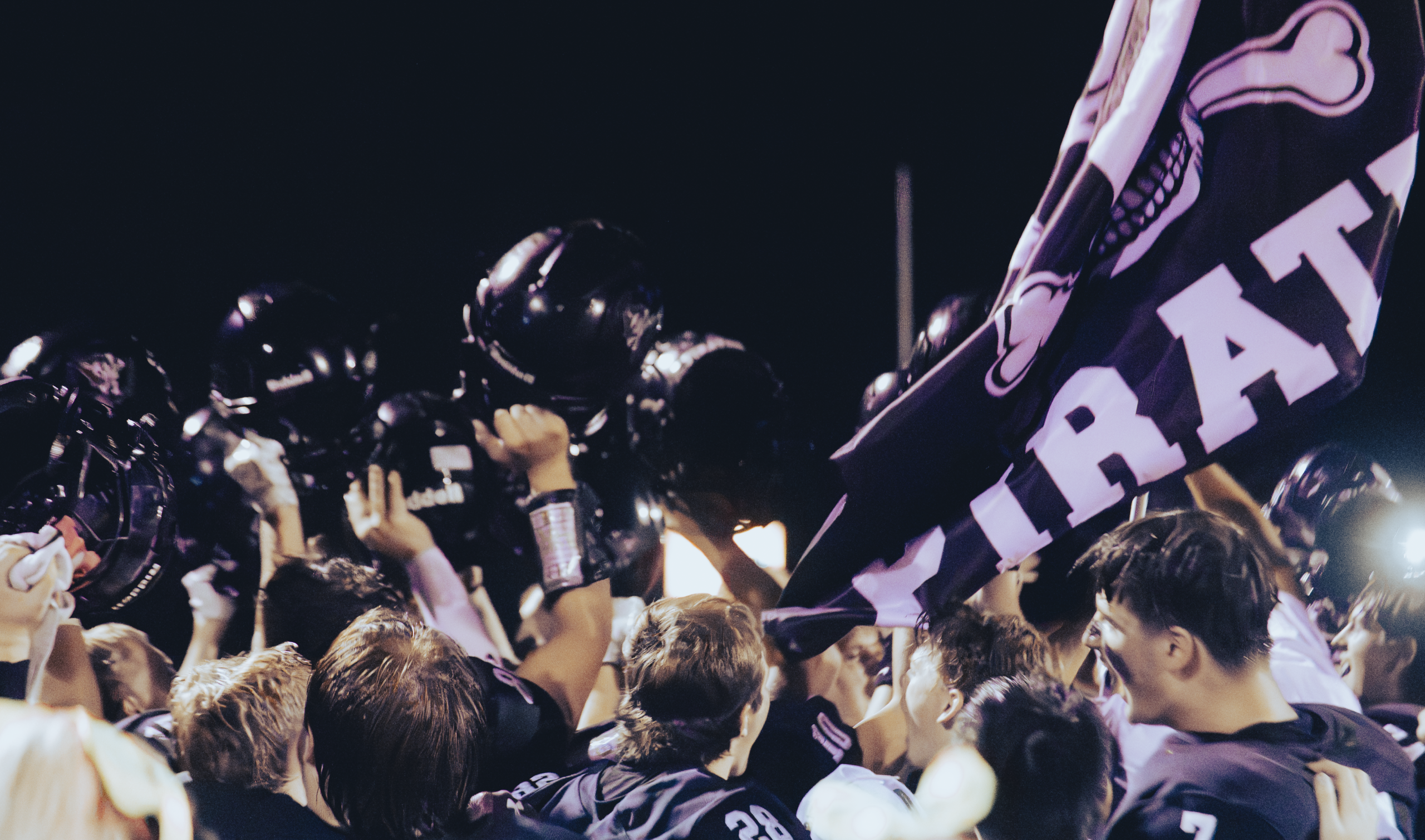
It also happened to be a good night to be a Pirate.
Dover opened the 2026 season at home against Lavaca and came away with a 35–27 win.
Matthew Krentz (shhh… I know his family so feeling famous) rushed for 55 yards and two touchdowns while also throwing for 41 yards, and Jacob Glasspoole added another 48 rushing yards and two scores.
And there’s a little history tucked inside that win.
Dover football has had some lean years recently. The Pirates went 0–10 in 2025, and the program’s last playoff appearance was in 2016. I actually triple-source checked that information.
So a 35–27 home-opening win isn’t just another Friday-night score.
For a program trying to build something again, 1–0 is a pretty lovely place to start. New coach. Possibly a new ranking.
And I got to stand down there and photograph it.
Somehow, We Both Belonged There
By the end of the night, Robert was on one sideline doing chains.
I was wandering the other side with a camera and a woman I had basically appointed my mentor approximately ten minutes after meeting her.
The kids were there.
The Pirates won.
I learned more about sports photography in one evening than I probably could have learned from ten YouTube videos.
And two days later Robert found out that his temporary “I’ll help if you’re desperate” chain assignment had apparently turned into a permanent position with merchandise.
So I suppose this is our life now.
We still do not have a child on the high school football team.
But somehow Robert has a chains shirt, I have a field pass, and we’ll probably both be back under those Friday-night lights.
Sometimes you don’t exactly decide to step into something new.
You just keep saying yes to the next little thing, and suddenly you look around and realize you’re already standing on the field. 🏴☠️📷
People ask me all the time what my relationship with Kaleb’s biological mom was like.
I usually just tell them the truth: it was really good.
A couple of weeks ago, the kids were talking about how they came out of my belly, and Kaleb started asking questions. It wasn’t some deep or sad moment. He was just curious.
He asked who his mom was, so I told him her name.
Then he asked why he didn’t stay with her.
I told him, “She was really sick, and she wasn’t completely sure she could take care of you. So I asked her if I could have you, and she let me.”
And that was pretty much it.
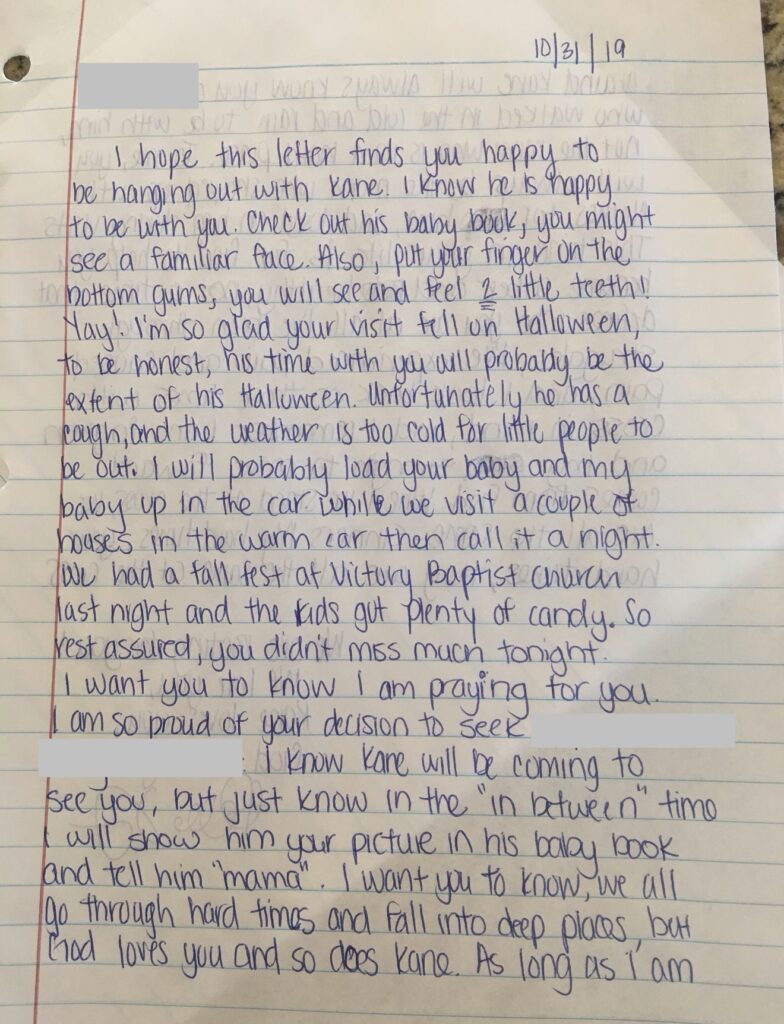
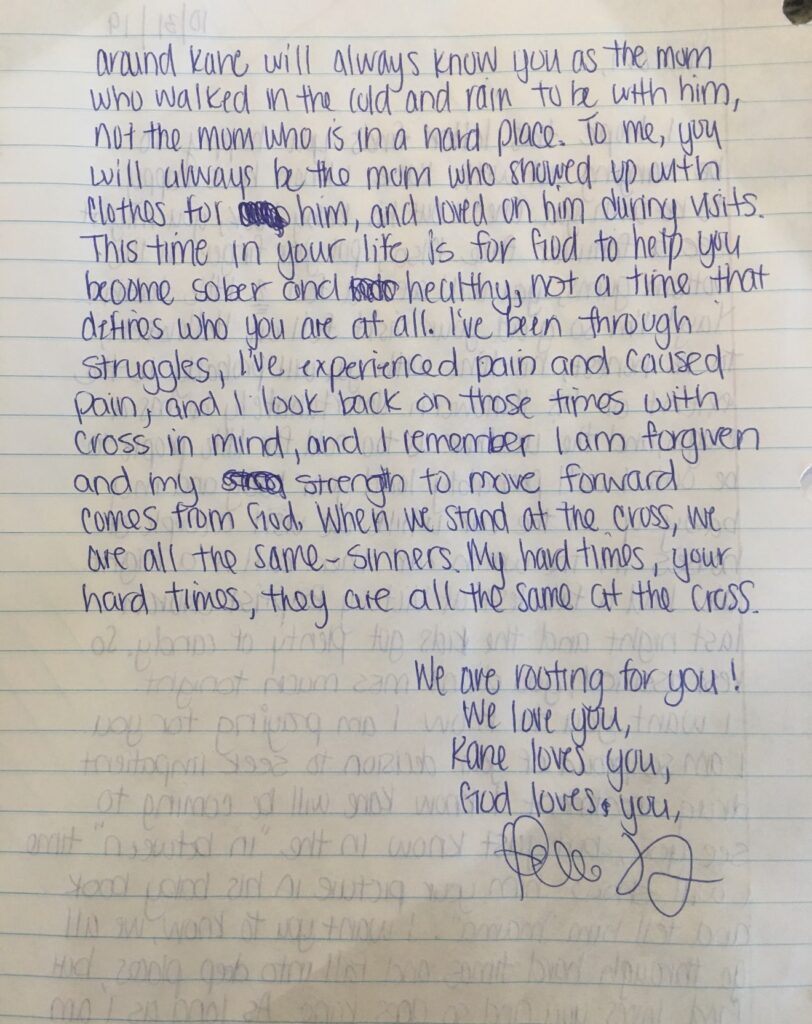
Then this week I found this letter.
I wrote it to his mom on October 31, 2019. He had only been living with us for a few months. In foster care, once a child has been in care for 15 of the previous 22 months, the state is generally required to file for termination of parental rights. So at that point, we were nowhere near knowing how his story would end.
Back then, his name was still Kane. I loved him already, but I had absolutely no idea that I would eventually adopt him or that one day he would become Kaleb.
At the time, his mom had made the decision to go into inpatient drug treatment.
And apparently I wrote her this.
Reading it seven years later, one part made me question myself:
“As long as I am around Kane will always know you as the mom who walked in the cold and rain to be with him, not the mom who is in a hard place.”
And another:
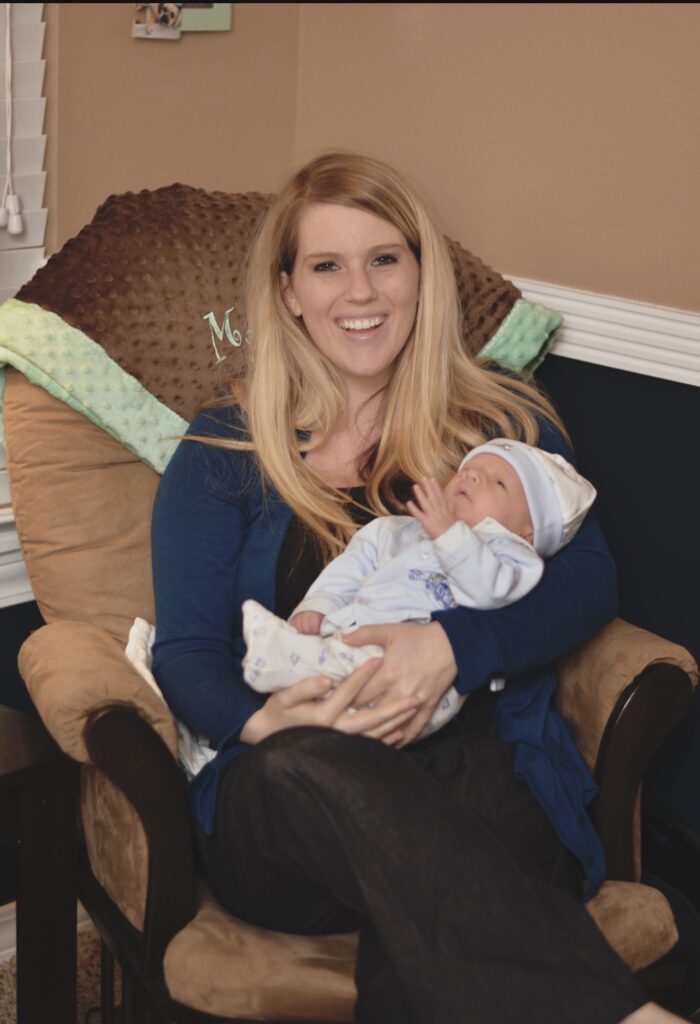
“I will show him your picture in his baby book and tell him ‘mama.’”
Have I kept this promise?
It reminded me of a conversation we had in the car that seemed ordinary at the time.
Just me telling my son the truth: yes, he was loved. He didn’t become mine because nobody else loved him.
Here we were seven years later, he asked.
And I got to keep that promise.
I think this letter also answers the question people have asked me all these years about how I could have such a good relationship with his mom.
Kaleb has always represented a whole person to me.
Not just my child.
He had a name before the one I gave him. He had a mother before me. He had a history that started before he ever entered my house.
And loving him meant loving all of him.
Supporting his mom was never separate from loving Kane. It was one of the ways I loved him completely.
When I wrote this letter, I loved that little boy desperately. And I desperately wanted his mom to get healthy.
Those things weren’t opposites, even though her getting healthy could have meant that he left me.
That may be one of the hardest things foster care ever taught me:
Sometimes loving someone completely means loving them enough to want what is best for them, even when where they may end up doesn’t line up with what you want.
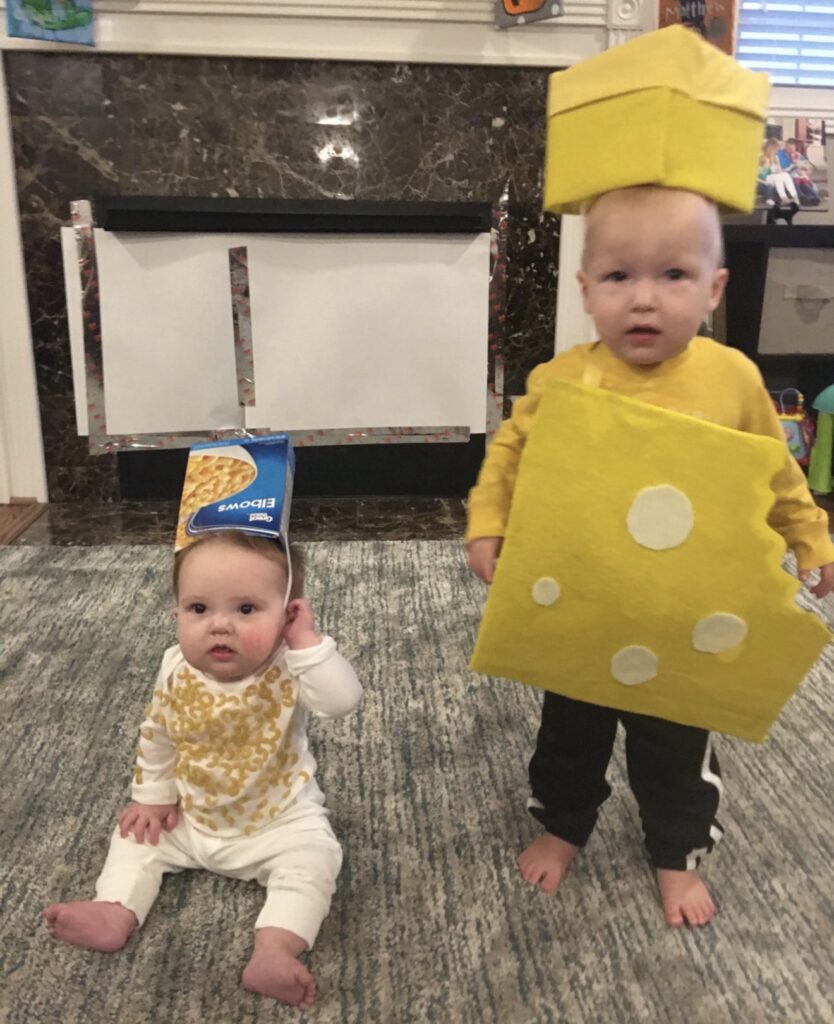
That Halloween, I wrote that I would probably load “your baby and my baby” into the car together.
And here they are.
My baby and her baby.
I just didn’t know yet that one day they would both be mine.
I don’t know what foster mom might need to hear this today, or what biological mom might need the encouragement.
But a hard chapter does not have to become someone’s entire story.
And loving a child well sometimes looks like refusing to let it become their mother’s entire story either.
I arrived at the hospital in the late hours of the night to induce the delivery of my son.
A pot of gold waiting at the end of a colorless rainbow.
A baby who never got the chance to be born, followed by a pregnancy complicated by a subchorionic hematoma that gave this baby only a 50% chance of survival, leaves a woman clenching her fists as tightly as she can to hope—all while preparing for the fall.
Prayers for God’s mercy on a fallible woman became regular conversations in our house.
Once, in the shower, with a large pregnant belly and an overwhelming feeling of helplessness, I leaned on the only One I believed had the power to change an outcome I could not control.
On my knees, water dripping down my naked body, I begged God to make Matthew mine.
It was a request I didn’t feel completely worthy of asking.
I had a Doppler at home to listen to Matthew’s heartbeat. Most mornings, I checked.
Hearing that little gallop gave me something pregnancy otherwise couldn’t: proof. For that moment, my baby was alive. He was still there. We were still moving toward the finish line.
I thought I needed to get him born.
If I could just get him here safely, maybe I could finally exhale.
I didn’t know yet that the fear would come with me.
Before pregnancy, I was happy, outgoing, and enthusiastic about life. Depression was not something I knew intimately. In fact, I remember someone I knew struggling with depression and making a comment that they needed to do something about it.
Get help.
Make a change.
Do something.
I didn’t mean to be cruel. I simply didn’t understand yet that sometimes a person can desperately want to get better, do the things she’s supposed to do, and still wake up sick the next morning.
I was about to learn that the hard way.
But here we were.
Our pot of gold.
The hospital hung Christmas lights every December, and I had told Robert that if I ever had a baby there, I hoped those Christmas lights would somehow make the cut into the final scene.
They did.
It was a long labor, but I remember the miracle of seeing a real-life baby in front of me.
He cried.
The world around us seemed to light up like a spotlight had suddenly been turned on in the room.
I took my baby and smiled.
Then he closed his eyes.
And I lost my breath.
“He’s dying. Please help him. Take him.”
I screamed for someone to help him.
It shocked everyone.
Including me.
Matthew wasn’t dying.
He had simply fallen asleep in his mother’s arms.
For months, I thought I just needed to get him here safely. But when he finally arrived, something inside me didn’t receive the message that the emergency was over.
I had my baby. I still needed proof that he was okay.
We had no idea this would be the beginning of a season of sorrow.
⸻
We made our way home, and I rocked Matthew in his glider and nursed him on demand.
He wasn’t nursing well, and his weight became something we legitimately needed to watch. I took him to the hospital every Friday to be weighed and kept track of that little piece of paper like it was a certificate of survival.
Eventually, my anxiety won, and I supplemented more and more.
That wasn’t my plan.
But I could not tolerate feeding my baby without being able to see and measure how much milk he had actually gotten.
A few days after delivery, I was struggling even to get up and grab Matthew because of tearing and stitches. I wasn’t getting much sleep. I wasn’t drinking enough. I wasn’t eating enough.
I remember my skin even feeling different.
Once I healed from the physical pain, I realized I was living in a pool of grief.
This was not what I pictured.
This was not what Facebook made motherhood look like.
People smiled in pictures. They doted on their babies. They put a sticker on their baby’s onesie every month and photographed the milestone.
I had the monthly sticker.
I had the camera.
And I stood behind it feeling like a fraud.
⸻
It was a slow fade.
At first, I worried about breastfeeding and Matthew gaining weight.
But underneath those ordinary concerns, something much larger was taking shape.
I loved him more than anything, but he represented something I had not quite been able to wrap my head around:
Someone needed me now.
My life was no longer entirely my own.
And I had a problem with that—not because of Matthew, but because I didn’t feel like I had lived my life in a way that could guarantee Matthew would always have me.
My mom almost died from stage 3 breast cancer when she was 28.
I was nine.
She tried to go to a doctor, and they turned her away because they thought she was too young. She was postpartum, too, and she was initially told the lump was a swollen milk duct.
A year later, it was still there.
It was cancer.
My mom cried.
My mom thought she was going to die.
I thought she was going to die.
Before Matthew, those memories belonged to my childhood.
After Matthew, I could suddenly see them from my mother’s side.
And worse, I could see them from his.
⸻
Before motherhood, I jumped out of airplanes for fun.
People told me I should get mammograms because of my family history.
I didn’t go.
In fact, I went to tanning salons instead.
I was quivering as all of this began unraveling in my mind.
I loved my son more than life, but suddenly every careless thing I had ever done with my own life felt like something that might cut our time together short.
The tanning beds.
The screenings I skipped.
Every stupid risk that once belonged to a young woman who assumed she had plenty of tomorrows.
Now somebody needed those tomorrows from me.
And I couldn’t promise them to him.
I couldn’t bear the thought.
But the thought kept finding me in my dehydrated, sleep-deprived slumber.
The glider where I had started out rocking Matthew became a place in the house I feared, simply because I knew my thoughts became louder there.
My inner reprimand screamed at me from the corner of that room.
Eventually, I stopped going in there.
The more I thought about all the normal young-adult choices I’d made—choices that no longer felt normal in this state of mind—the more I thought about life and death.
And then another realization hit me:
I had brought Matthew into this world, and someday he was going to die.
We all are.
I had always known that.
But suddenly I couldn’t understand how everyone else was okay with it.
I felt selfish.
I loved him desperately, but part of me wished I hadn’t exposed him to a world where suffering and death were inevitable.
I hated myself for doing this to both of us.
I even resented my own parents for having me.
I never wanted to hurt Matthew.
I never had thoughts of hurting him.
Quite the opposite.
My mind was consumed with preventing anything from ever hurting him.
That was part of the prison. I had assigned myself the impossible responsibility of protecting another human being from everything—including the parts of being human that no mother can prevent.
My thoughts became a prison.
And I was suffering.
⸻
Motherhood came with responsibilities I understood.
Feed him.
Bathe him.
Change him.
Take him to the doctor.
Keep him warm.
Love him.
But somewhere in my postpartum mind, other responsibilities quietly appeared on the list:
Keep Matthew alive.
Keep yourself alive so you can raise him.
Never let anything separate you.
Those were the responsibilities I could never finish.
There was no box I could check that said:
Matthew will always be safe. ✓
There was no test I could take that promised:
You will live long enough to raise your son. ✓
But my brain treated those impossible guarantees like ordinary maternal responsibilities.
And every day, I felt like I was failing to complete them.
The only way I knew how to emotionally survive was to try to get ahead of everything that could possibly go wrong.
Keep harm out of Matthew’s way.
Find anything that could be wrong with me before it was too late.
Prepare for the worst before the worst could surprise me.
But that was a much bigger job than it sounds like on paper.
What if my mother’s cancer was coming for me?
Was the buzzer about to go off on my own life?
How do I prevent Matthew and me from separating?
What if I’m already too late?
Will I go to heaven?
Is there a heaven?
Is there a God?
Of course there is a God.
But what if there isn’t?
Then dying becomes much worse.
Then I don’t leave my son for a better place.
I just leave him.
There was an ambiguous sense of impending doom, but I didn’t understand yet that the catastrophe was happening inside my mind, not in the world around me.
I couldn’t understand how other people could be happy.
How could they be so calm knowing what they had exposed their children to simply by bringing them into the world?
And if I admitted that I was having these thoughts, how would everyone look at me?
Am I broken?
⸻
Christmas came only a few weeks after Matthew did.
I remember sitting with extended family while everyone opened presents.
At some point, I started crying.
People noticed.
They teased me a little for being emotional, and I gave them the explanation that made sense.
“It’s just so sweet.”
And it was sweet.
That wasn’t a lie.
But it wasn’t why I was crying.
I thought it might be my last Christmas.
I was sitting in a room full of people who loved me, holding the baby I had begged God to give me, surrounded by Christmas presents and family and all the evidence of a life I desperately wanted.
And inside my mind, I was already grieving leaving it.
Nobody in that room knew.
I had given them an explanation they could understand.
⸻
I could barely bring myself to talk to Robert about any of it.
At one point, Robert needed to travel out of state for a week, and I knew I wasn’t comfortable being alone with Matthew for that long.
So we made a plan.
Every single day Robert was gone, someone from our family came to stay with me and Matthew. For that entire week, we made sure I wasn’t left alone trying to carry everything by myself.
We were taking precautions.
We knew I was struggling.
People were helping.
And I was still sick.
Having someone there didn’t silence my thoughts. It didn’t suddenly make me feel like myself again. But it made those days more manageable.
Even on ordinary days, I barely made it to 5:00.
When Robert came home, I felt relief.
But the next morning, the thoughts were waiting for me again.
How do I control them?
Why won’t they leave?
I was supposed to love this season of my life.
Everyone online seemed happy.
I wasn’t happy.
I was sad.
And I was living in an almost constant state of terror.
I couldn’t get help by staying silent.
But I couldn’t tolerate the thought of the look I might get if I admitted everything out loud, either.
Then I did admit some of it.
And afterward, I didn’t always want to do it again.
Because how many times can you tell the person you love that you’re still not okay?
How many times can someone ask whether you’re feeling better before you desperately want the answer to finally be yes?
Sometimes I wanted everyone to believe I was getting better.
Sometimes I wanted to believe it myself.
I was tired of being the sick person.
I was afraid that if I kept talking, people would eventually realize just how consuming this had become.
They would think I was crazy.
There was something wrong with me.
It was dark.
I was never okay.
How long can I live in this darkness?
Will I ever see the light again?
Will I ever genuinely laugh again?
How long can my heart race and break?
How long can I live in constant emotional agony?
How long can it feel like a thousand miles just to walk into the kitchen and make breakfast?
I became afraid of waking up because I knew the pain would still be there waiting for me.
And yet I was terrified of dying because that meant leaving my son motherless.
I desperately wanted to live.
I just desperately needed this to stop.
There were moments I wished I had never been born.
Not because I had a plan to end my life.
I didn’t.
I didn’t imagine how I would do it.
I didn’t want to leave Matthew.
That was the very thing I was terrified of.
I wanted an end to the unbearable feeling of being alive like this.
I was stuck.
⸻
And perhaps the strangest part was that I didn’t know this was postpartum depression.
I thought I knew what postpartum depression looked like.
In my mind, postpartum depression meant a mother didn’t want her baby. Maybe she couldn’t bond with him. Maybe she regretted becoming a mother. Maybe she wanted to hurt herself or her child.
That wasn’t me.
I wanted Matthew.
I had begged God for Matthew.
I loved holding him. I wanted to nurse him. I wanted to take care of him.
I had never thought about hurting him.
I didn’t want less motherhood. I was terrified of losing it.
So I didn’t understand what was happening to me as depression.
It felt like fear.
It felt like danger.
It felt like something terrible was coming and everyone else was inexplicably calm about it.
It felt like an enormous responsibility I couldn’t figure out how to complete.
I didn’t understand that postpartum illness could look like this, too.
I only knew that something had happened to the woman I used to be.
And I wasn’t okay.
⸻
Five weeks postpartum, on a Friday night, I went to the hospital to have Matthew weighed.
I saw my OB in the elevator.
With tears threatening to stream down my face, I said, “I think I’m going to have to call you Monday.”
He looked puzzled.
“Is everything okay?”
And for the first time, I found words for it.
“I’m not okay. I think I’m depressed.”
He was stunned.
I don’t think he understood yet what kind of depression I meant.
“You wanted this baby so bad.”
“I know,” I told him. “But I feel like I can’t keep him safe. I’m having thoughts about whether God is real. And then I feel hopeless.”
The strange thing was, he was right.
I had wanted this baby so bad.
I had begged God for him from the floor of my shower.
I had spent months terrified that I would lose him.
I had listened for his heartbeat.
I had prayed over the bleeding.
I had waited for him.
I had wanted him more than anything.
And none of that protected me from postpartum depression.
In some ways, how desperately I loved him became tangled up in it.
⸻
I did what I knew to do.
I told my doctor.
I started medication.
I attended Bible study.
I prayed.
I accepted help.
My family showed up.
And I was still sick.
There wasn’t one morning when the medicine suddenly worked or one Bible verse that snapped me back into myself.
Sometimes Bible study comforted me. Sometimes questions about God and eternity frightened me even more.
But I kept going.
Getting help did not mean I immediately got better.
That battle went on for about a year.
And that taught me something I wish I had understood before I ever made that careless comment about someone else’s depression:
Wanting to get better and knowing how to get better are not the same thing.
Neither is getting help and immediately being well.
I had done something about it.
I was still doing something about it.
And for a while, I was still sick.
⸻
I became someone I didn’t recognize.
A fun-loving, social, enthusiastic woman quietly became afraid to say too much—to accidentally reveal to the outside world what was happening inside her.
Somewhere inside me, I knew other people weren’t seeing what I was seeing.
But knowing that didn’t make it feel less real.
The cancer diagnosis hadn’t happened.
The funeral hadn’t happened.
My son had not lost his mother.
The catastrophe existed in my mind.
But the terror existed in my body.
And from inside that terror, possibility could feel almost indistinguishable from reality.
I had spent the beginning of Matthew’s life asking God for something impossible:
Let me know we’re going to be okay.
Eventually, my prayers became smaller.
I asked God for five years.
Just five years to be his mother.
Five years to take care of him.
Five years to get him a little bigger.
Five years before I had to leave him.
That was all the frightened woman I had become could bring herself to ask for.
Matthew was born December 7, 2012.
It has been almost fourteen years.
⸻
Author’s Note
This is not what postpartum depression looks like for every woman.
This is what it looked like for me.
It happened many years ago. I have been off antidepressant medication for several years, and I am doing well today.
I share that not because medication is the right answer for every person, or because my recovery followed a straight line.
It didn’t.
But during that season, honesty and medical treatment were invaluable to me.
I told my doctor.
I took medication.
I prayed.
I went to Bible study.
I accepted help.
My family showed up.
And sometimes I still woke up sick the next morning.
Recovery was gradual.
There is something else that stayed with me.
Robert will tell you that if I hear someone has had a baby, chances are I’m going to make them dinner.
Sometimes I know the mother.
Sometimes I don’t know her at all.
There are women who have eaten meals I’ve cooked who probably couldn’t pick me out of a crowd. Maybe Robert works with their husband. Maybe I simply heard that somebody brought a baby home.
I don’t need to know whether she’s struggling.
That’s sort of the point.
I remember what it was like when people asked how I was doing and I didn’t know how to answer.
I remember wanting desperately to feel better.
I remember being exhausted by my own thoughts.
And I remember that sometimes another question—even one asked with tremendous love—felt like one more thing I had to answer.
So I don’t usually knock on the door unless they want company.
I leave dinner by the door.
No diagnosis.
No expectation that she tell me how she’s doing.
No requirement that she be struggling enough to deserve help.
Just dinner.
Because I can’t tell by looking at a new mother which one is having the greatest experience of her life and which one is quietly trying to make it until 5:00.
Sometimes showing up for someone means showing up with help instead of another question.
If you are somewhere inside your own version of this darkness, I hope you will tell someone the truth.
And if you’ve already told someone and you’re still not better, tell them again.
I once thought getting help meant getting better.
Now I know sometimes getting help simply means having people help carry you while you get better.
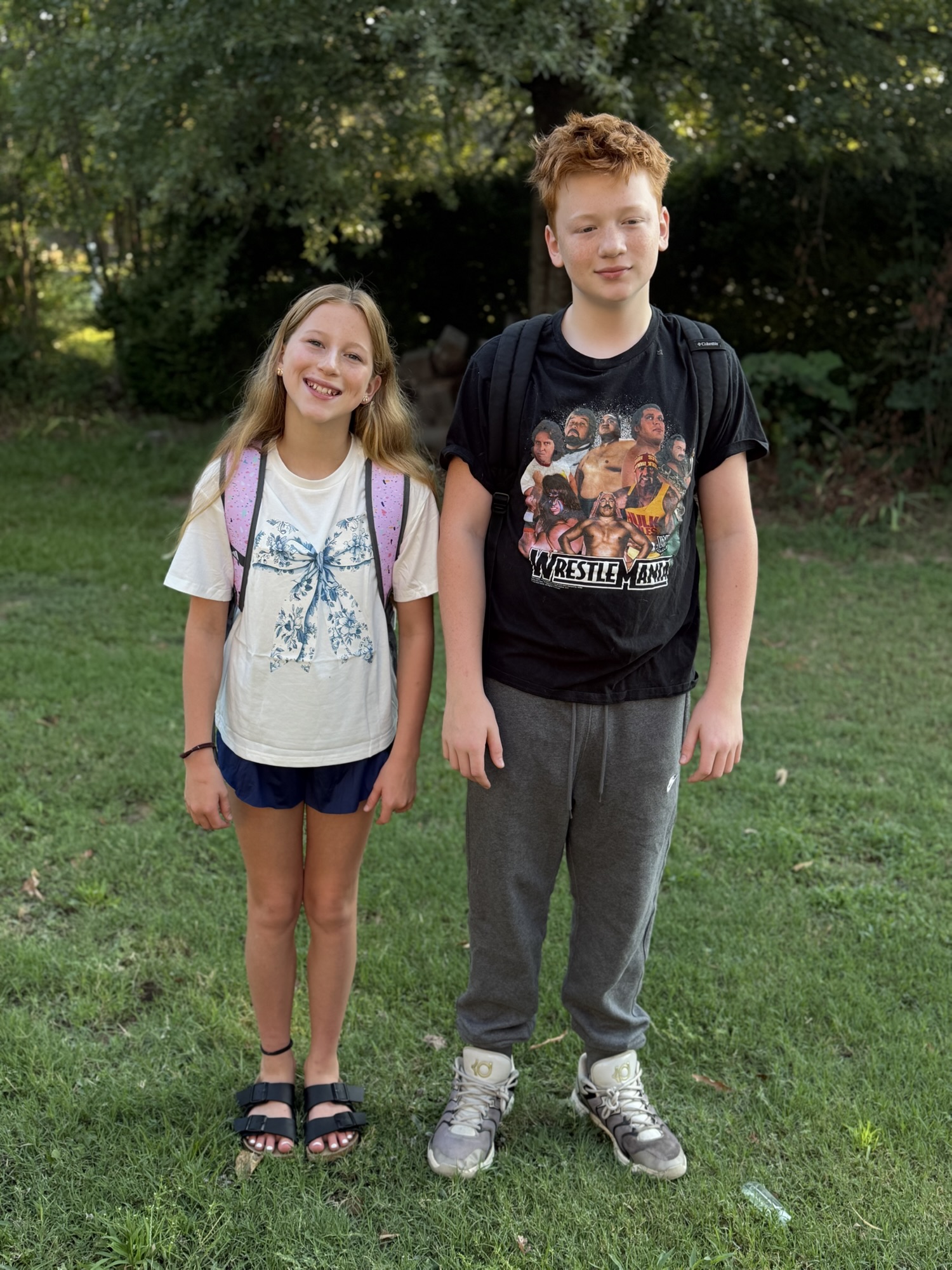
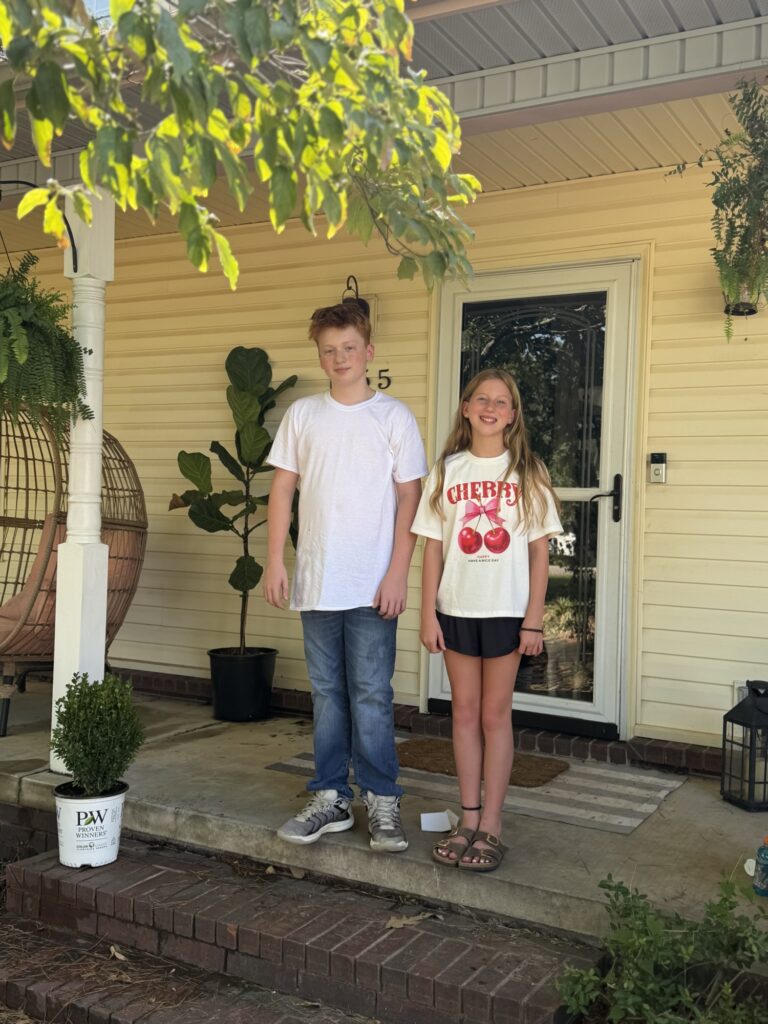
I just dropped the big kids off at school for their second day. I have a picture to prove it.
I also took one yesterday after school because I forgot to take one before school. After all, we were two hours late.
Why?
Well, our neighbor let me know she saw trash all over our yard and added that it might be a bear. She told me to check my security cameras.
We don’t have cameras in that particular spot, and I don’t know the password to the cloud system.
I looked for evidence of scratch marks or bear prints.
Mystery remains unsolved. Case was cold by 8 a.m.
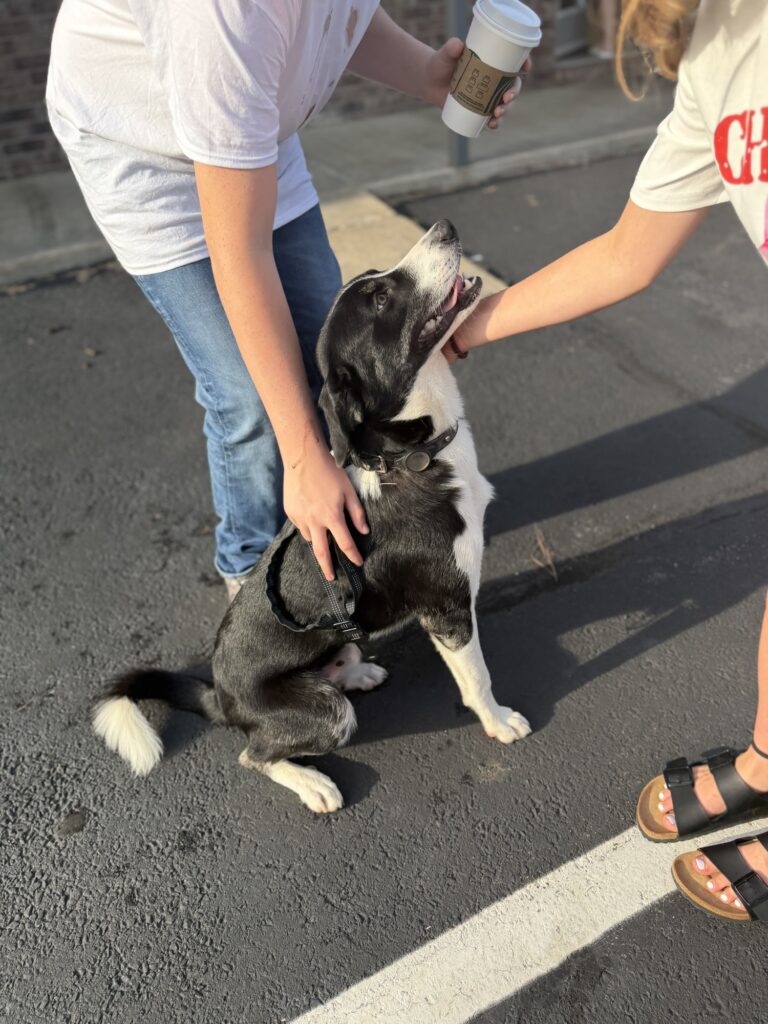
Our dog got neutered and needed to be picked up, and the kids begged to go with me. How could I say no to that?
Though I tell Robert all of the time I want to be pursued, chaos never fails to pursue me. But I meant him, not chaos.
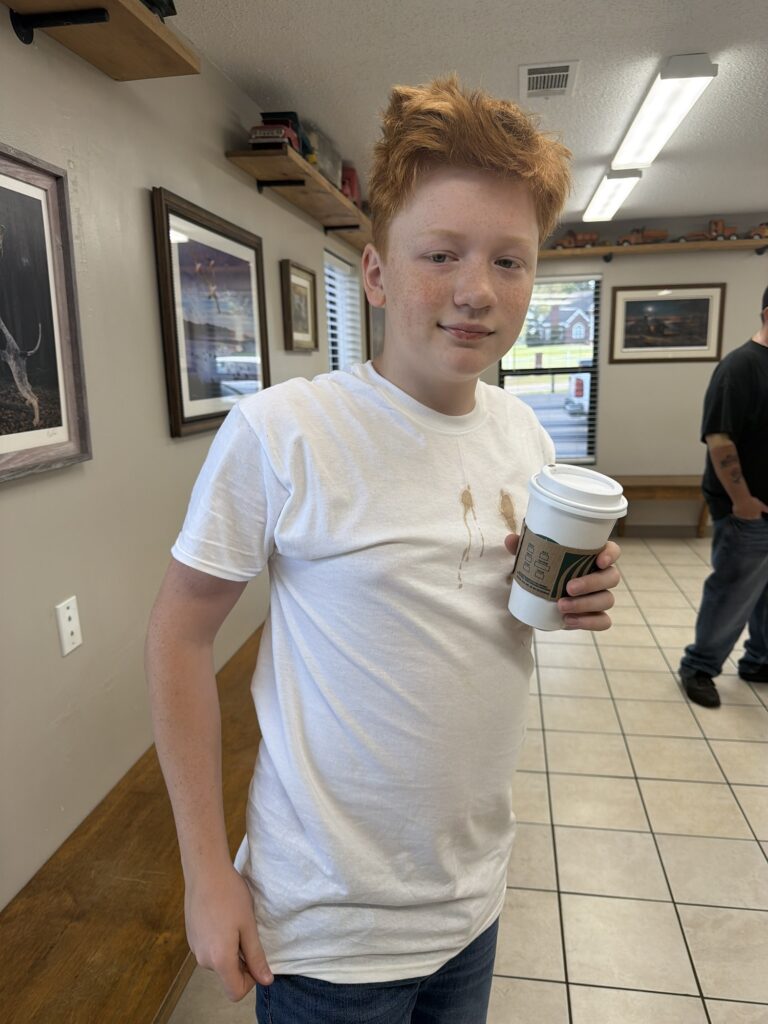
I grabbed Starbucks, and my lid wasn’t all the way on, so I wore my overpriced coffee instead of drinking it.
I treated the kids to Starbucks. Matthew made sure to thank me with a punishment: hot chocolate and a white T-shirt.
What was I thinking?
But more importantly, I actually don’t understand his wardrobe choice anyway. We bought name-brand shirts at $30 a cloth, and he picked the white T-shirt that was $8 for a pack of five.
At least we all got the endorphin release we showed up for when we picked up Scout because, boy, was he glad to see us again.
At first he didn’t recognize us when the vet tech brought him out, but once he smelled us and recognized Abigail’s high-pitched “Babies!” he knew he was about to jailbreak out of there.
He started crying endlessly and jumping all around.
Then he got Abigail dirty, too.
The rescue had us take Scout to a vet in Clarksville. I wasn’t particularly excited about that part, but the kids and I did have fun listing all our dogs in ChatGPT and asking it who would win in a fight between them and a black bear.
The storytelling made us all laugh because it described our dogs so well.
I got Scout home, the kids changed, and then off to school they went.
The kids have one rule for their unpaid Mumber (Mom Uber) driver.
No Mom music over volume 2 under any circumstances in ANY parking lot associated with these sophisticated heathens. Like, Bone Thugs and Harmony, you don’t get a free pass on this rule.
So I turn down Pandora on my phone as we approach the premises of learning and drama, as I have been instructed.
“Come on, kids. Let’s hurry inside.”
I unplug my phone, and the phone and Expedition volume aren’t in sync, so Def Leppard through the middle school parking lot?
Yes.
Matthew jumping out, covering his head with a backpack, and walking away swiftly? Also yes.
I thought about telling the front office why we were late, but then I decided that would be more work and she probably doesn’t care.
I barely cared, if that’s okay to admit.
That afternoon, I planned a special dinner for the big kids.
Chicken Alfredo, garlic bread, salad, and an ice cream bar.
I got their favorite toppings and anticipated their arrival.
That turned into a complete shit show.
Abigail ate by herself because she can’t eat at the dinner table lately without fighting with her brothers about the sound of their smacking and gulping.
She even gets on to me.
Sometimes I catch myself holding my breath so she doesn’t give me a dirty look.
I told her if she had nothing to say about her day, she could get the ice cream bar ready.
Well, she discovered that Matthew put the two tubs of ice cream in the refrigerator.
Then he put my P3 lunches and the boys’ Lunchables in the freezer.
We were able to salvage the ice cream for the night, but the second tub would not survive being put back in the freezer.
I laid out all the groceries for Matthew, and we counted how much money we actually wasted by not paying attention.
Almost $50.
He looked upset.
I asked him why he looked upset. I specifically asked, “Do you feel bad?”
He said no.
He said he didn’t think he was the one who did it, even though he was the one who put the groceries away.
We explained that the groceries didn’t grow legs and make it to the extra fridge on their own.
He said he put them all away but not in those places.
This was frustrating because the groceries had only been at the house for a couple of hours.
He wouldn’t own it, which was the most important part to us, or apologize.
Then Robert said he wasn’t in the mood for ice cream,
So I didn’t have any either.
Jonah assured me that he had just discovered he likes melted ice cream.
Kaleb said he doesn’t like strawberry ice cream. It was Neapolitan, and I was about to scream. But then he said, “I am glad you got this kind because it’s good.”
I guess he didn’t realize it had a strawberry stripe in there, too. Kind of like how he hates onions, and I hope he doesn’t notice them in my chicken spaghetti.
So once the kids finished, we went to bed, and I wondered how all of this ended without me getting ice cream or learning about the kids’ day.
I woke up at 1:00 a.m. feeling sugar-short, so I had a handful of Oreo Thins and then went back to sleep feeling satisfied.
Not as good as a sundae, but better than not having dessert at all.
Robert talked to Matthew before bed.
When we woke up at 5 this morning, I could tell Robert was a good mix of agitated about Matthew’s thoughtlessness and melancholy about how the night ended, so I started “Just Give Me Jesus” on Alexa with a soft smile and a kiss.
Sometimes I want to scream for him to snap out of it, but sometimes you gotta let Jesus fight those battles for you.
I say that with a mischievous smile because I know him well enough to comfort him without trying to talk him out of a mood.
This morning was much better.
I put this prompt in ChatGPT, and it finally got the conversation that I was reaching for yesterday:
“Right now, I’m driving Matthew and Abigail to school. Matthew’s 13, and Abigail’s 11. We need something to listen to on the way to school. Give us some encouragement for the day, some laughter, and give them something to challenge themselves with for the day.”
Abigail’s eyes got really wide because she doesn’t realize that I gain some understanding about her through ChatGPT in other chats, so when it said, “Abigail, you’re 11, which means you’re entering the era where you can simultaneously be incredibly mature and become personally offended because somebody breathed weird near you. Also normal.”
Her mouth dropped. Her eyes opened wide.
She said, “Mom, is there history in this text or is this a new conversation? How does it know all of this about me?”
I let her stay puzzled because, as I said, I am mischievous, in an innocent way, of course.
Abigail told me she had done most of what the response said for today yesterday.
They had a new girl, and a teacher asked Abigail to make her feel welcome.
Abigail said, “Mom, she was so pretty, so I just looked at her and said, ‘You are so pretty.’”
I love that because I tell women they are beautiful and hot all the time.
Because I am a mom.
I know how it goes.
I am married, so I don’t want that from other men. I know my husband doesn’t always know when to say it, so we women have to remind each other that we still got it.
I am glad Abigail is not trading compliments to get one in return.
She sees someone she genuinely thinks is pretty, and she let her know.
That’s it.
That matters.
It might have changed that girl’s entire first day of school.
And I made it. I didn’t cuss at anyone through all of that.
But I cussed here, so I guess it had to come out somewhere.
I used to believe Robert had to plan and initiate our dates for them to feel meaningful.
I thought that was what being pursued looked like.
If I planned the evening, asked for the time, or told him exactly what I wanted, I felt that somehow it would not count. The romance would feel less romantic because I had helped create it.
But the older I get, the more clearly I know what I want. And the more comfortable I become asking for it.
There is a kind of freedom in being honest about your desires. In believing it is okay to let vulnerability win and simply say, I want this. I want you. I want time with us.
So that is what I did.
I could have waited for Robert to initiate a date night.
And I have in the past waited until resentment brewed.
I could have hoped he would notice the opening and plan something himself.
He’s missed those hints in the past, too.
I used to wonder, “Does he see me?”
But this time, I tried something different.
Instead, I sent the text.
We had a few children away, and the ones who were home rarely interrupt our date nights. We also had some wins from the week worth celebrating.
So I told him I wanted him. I asked him to bring home dinner so we could eat outside, have a drink, and spend the evening together by the pool.
I built the doorway and waited to see whether he would walk through it.
He did.
And it became one of the most romantic nights we have had in a long time.
The anticipation began for both of us as soon as I sent the text.
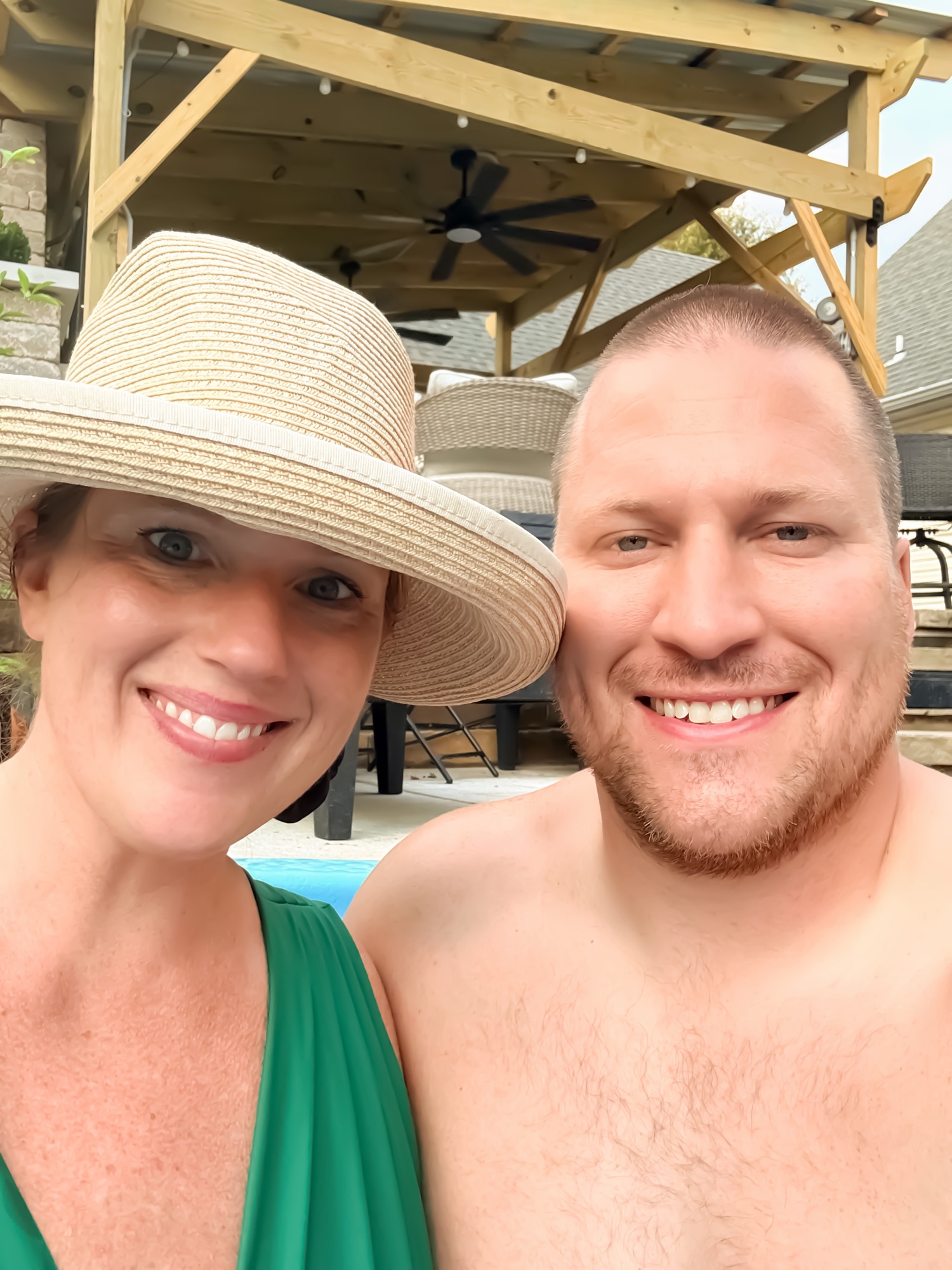
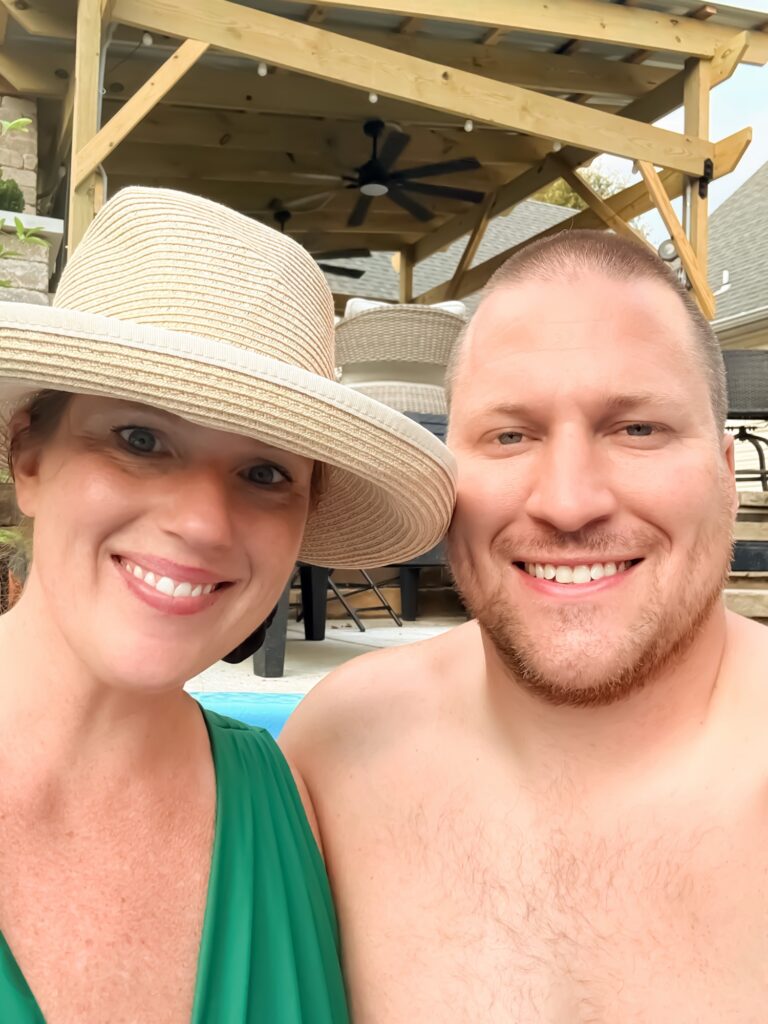
He came home with Ridge Brothers barbecue and a big smile. We ate outside at our outdoor kitchen while the sun went down. We talked. We swam. We talked about our children, because apparently even when parents escape their children, they still take them along in conversation.
By the time we climbed into the hot tub beneath the stars, the entire evening had slowly drawn us toward each other.
There was no abrupt switch from responsibility to romance. We had been walking there together all evening.
We began kissing like teenagers again.
Just as we started to kiss, one of the songs from our wedding began playing.
Robert and I both love rock music, so naturally we found ways to include it in our wedding. “Everything” by Lifehouse played as our ceremony began. “Never Gonna Be Alone” by Nickelback played during our joint wedding slideshow.
That night, when Nickelback began playing beneath the stars, I realized something.
We had made a promise all those years ago without fully understanding what it would require.
And somehow, we had kept it.
Not perfectly.
Not easily.
The clock moved faster than we imagined it would. There have been moments when we reached for our marriage, and moments when we pulled away. Days we wish we had not allowed to slip past us. Moments that, had they been our last, we would have regretted taking for granted.
But we kept finding our way back.
The words that reached me most that night were the promise not to miss another day.
Because love is not only a feeling you happen to receive.
Love is a gift you keep choosing to give.
It looks like dependability. It looks like keeping promises when keeping them is hard. It looks like holding tightly without pretending you have never disappointed each other.
It is loving someone beyond their mistakes.
Forgiving each other in disappointment.
Celebrating each other in success.
And sometimes, it looks like refusing to deny yourself the gift of asking for what you want.
I used to think that initiating the evening meant I was not being pursued.
But I understand it differently now.
I opened the door.
Robert walked through it carrying barbecue, wearing a big smile, and ready to meet me there.
I tried writing outside, but the sun beat me to my seat. I landed in our room, on our bed, on my side of the bed, of course. I’m just here to wish you a happy 40th birthday.
I really didn’t want to dive into our love story on your birthday because this is about you, but your life has impacted mine in such a meaningful way that I can’t separate that story from the way you lived in front of me for the past 18 years, from how I came to understand the character of Jesus.
I think the kids will like this one when they’re older.
Summer 2008:
I had recently moved back home from attending college in Florida. I had a tough year in Florida and got in way too deep in a relationship. I left mid-semester, and I was trying to start over. A new romantic relationship was not on my radar.
I knew of your dad from his regular Sunday evening visits to Outback with Phil. He always sat in another person’s section so I never served him, but I did occasionally say hello.
When you came to Outback with him during your summer break, Susan went back to the kitchen and said that Tommy’s youngest son was eating with him. Ironically, she wasn’t trying to set you up with me at all. She was talking you up to the girl your dad had actually brought you there to meet. She said that you were in college, had straight As, were thinking of attending UT for your master’s, and you were a real catch. I was curious, so I came over and said hi. Then I didn’t see you again until the end of the summer.
She was right. You looked like a good catch. I just didn’t know then that the best part of you had nothing to do with the résumé she was sharing.
In the meantime, I was working on myself. My family traveled a lot and didn’t go to church, but I felt a tug I couldn’t explain that drew me closer to God. I asked the only person I knew who went to church similar to the one I went to as a little girl, and I started driving 45 minutes on Sundays to go to church with her.
Then you came back to Outback, and I told you and your dad how I got kicked out of this super snobby private school because I wouldn’t go to chapel.
Then you asked what school it was…and we both laughed because we realized we had not been that far apart in this world after all. You were there at the same time as me, but you were just older.
I told you how I was going to church with Bethany, and you invited me to church with you.
That was the church you grew up in.
That was the church I started attending alone even when you went back to college in the Fall.
That became the church where we got married.
Then we moved, and it became the church we later brought our kids back to visit.
I still love that church.
But to tell you the complete truth, the church was only the backdrop to what I was witnessing right in front of me.
You changed my life and my view of Jesus.
I met a lot of people in that Baptist private school, but, Robert, there is no one like you.
I was amused from the start.
It wasn’t because you were Hit Man Jacks and Captain on the football field in high school.
It wasn’t your conviction for the Lord.
Or the 3.98 GPA.
Or that you knew a lot about the Bible.
It wasn’t that you’d spent your life quietly honoring your convictions about purity.
Or even your confidence about heaven.
Those things were admirable. They just weren’t what changed me.
The world might label you a believer based on those merits.
What impacted me was much deeper, though.
The simple truth is this: seeing Jesus in you never came from what you said about yourself.
I had to ask, and you responded as if it were no big deal.
That is just who you are.
The humility of it all is exactly the fertile ground where my faith could grow taller than the surrounding weeds.
You’ve never made me feel like you were leading me to Jesus. You’ve always said you chose me because of my heart. You wouldn’t have chosen someone to save.
You’ve always made me feel like we were growing closer to Him together.
And I never learned much from what anyone has said, but I came to know Jesus even more because of what you did to teach me.
You’ve admitted when you were wrong without needing me to admit my part in return.
Which, in the end, made me want to admit my part.
I know you know more about the Bible than I do, but every time I remind you of that, you shake your head no before I can finish my sentence.
I’ve seen you take the blame for things that aren’t your fault at work.
You aren’t a gatekeeper to heaven with a scorecard.
People call you when they are struggling.
Not because they think you are perfect.
But because they know you know you aren’t, and you’re not afraid to admit that.
I may slip a curse word every now and then.
I like an occasional glass of wine.
Even still, I know you aren’t looking at me through the lens of a religious leader in the church, but rather through the loving eyes of Jesus who wants me to sit with him comfortably, even if I bring my sin and all.
I remember when we were dating, we would lie around your apartment, and I would ask you questions about the Bible, and you would say you didn’t know the answer when you were unsure.
You could have fooled me.
You grew up in a Baptist school.
You attended church every Sunday.
You went on a Mission trip.
You could have answered to the best of your knowledge to impress me.
But that isn’t you.
You are the one in the room not talking,
while quietly carrying more wisdom than the people doing all the talking.
That is the person who taught me how much Jesus really loves me.
Not because we attended church.
Not because you knew every verse in the Bible about God’s love and told me about it.
Not because when the world was being worldly in the years before we met, you were keeping your values and convictions.
None of that makes you the man who taught me about Jesus.
Growing closer to Jesus with you looks like, “Let’s look that up together,” instead of “I know the answer.”
And, “Felecia, you’ve been reading your Bible so much that you’ve encouraged me to read it more,” instead of, “This is what a holy woman does.”
It’s that you never once—and I mean not even once—reminded me of who I was at my worst.
You had a lot of high horses to ride on, but for the last forty years you’ve chosen to put other people in the saddle while you quietly steer them around.
That’s why people who are struggling call you.
But it makes me smile too, because a lot of them don’t know you as I do, and some of them might be more nervous than I was about showing you their broken pieces if they knew the truth I knew.
You’ll probably be uncomfortable with every word I’ve written here.
You’ll tell me I’ve exaggerated.
I don’t think I have.
Happy 40th Birthday.
Thank you for showing me what following Jesus is like more than any sermon ever could.