2 LORD, how long will I call for help and you not listen? I cry out to you, “Violence!” but you don’t deliver us.
Yesterday I read the book of Habakkuk. Today, I went back to slow down and study just the first two verses. Here are a few things that stood out to me.
I think sometimes, when things get hard, we assume it’s faith that gets lost. At first glance, that might look like what’s happening here. But when I look closer—when I read this with a magnifying glass instead of skimming the question as a whole—it tells a different story.
Habakkuk says, “How long…” And those two words actually signal the opposite of a lack of faith:
How long means he believes God can and will act.
It also means he has asked before, which signals endurance rather than abandonment.
He assumes God should hear andcan save, and that the frustration exists only because he believes God is who He says He is. (See Psalm 13 and Psalm 22.)
This is a deeply vulnerable conversation with God. It separates “God, if you’re up there…” from “God, I know You’re there, and I don’t understand this.”
The word “violence” (ḥāmās in Hebrew) reflects social collapse, not isolated crime. This isn’t about one bad moment; it’s about a system full of moral collapse.
Habakkuk is frustrated because he believes. That’s what separates his cry from unbelief. He can’t reconcile who he knows God to be with the fact that God is allowing this collapse.
Habakkuk is waiting. Not patiently, but honestly. And he’s waiting for God in a raw, spiritual way.
2025 was rough. Not in a dramatic way, but in the small ways no one sees. The kind where you drift further from where you want to be in inches instead of yards. Then one day you look up and wonder how you landed here. It’s never the big decisions that change where you end up. It’s the micro-movements; keeping your head down, watching your feet instead of looking forward, tracking the next step without making sure it actually leads where you want to go.
Today, I started the Book of Habakkuk. I chose it because it’s different. You don’t hear it referenced often in church, and no one names their child Habakkuk, but it’s thought-provoking.
In this book, Habakkuk asks God why He allows evil to exist. In this context, he’s referring to the Chaldeans—another name for the Babylonians.
They are wreaking havoc in Judah, corrupting God’s people, and their siege is only rising. Habakkuk confronts God.
He wants to know why God seems silent while injustice spreads—and why God would allow His own people to fall so far before intervening.
If I’m being brutally honest, sometimes I ask God the same questions while looking in the mirror. I’m not evil, but sometimes I lose my character, or at least the person I strive to be. It will be interesting to see how God responds as I read further.
If you’d like to slow down and look more closely at the text, you can read my reflections on verses 1–2here.
By April 2024, my dad’s metastatic melanoma had spread almost everywhere—lungs, liver, pancreas, bones, neck, lymph nodes.
His doctor didn’t offer hope. Just stabilization. He even said, “Let’s not talk about remission.”
But my dad—he’s not like most people. He believed he was going to beat it. Even after his doctor told him he probably wouldn’t.
I, on the other hand, believed every word. I read every PubMed article. Every single one said this was a poor prognosis.
And for the first time in my life—I resigned. I quit my Bible study after 11 straight years. I stopped reading Scripture.
I didn’t stop believing, exactly. I just stopped trusting that God was as kind as He claimed to be.
If that offends you, that’s fine. Just promise me you’ve been honest about your own beliefs before you judge mine. Because people who’ve never doubted usually aren’t the ones asking the hard questions— and you don’t go looking for answers if you think you already have them.
But here’s the part I wasn’t telling anyone: I didn’t have the emotional energy to fall apart. Not as a mom of four. Not as a wife trying to hold it all together.
So I didn’t cry. I didn’t scream. I just… shut down.
One day in April, we were all outside—me, Robert, the kids. It was one of those rare, golden spring days that shows up like light through a dusty window: soft, sudden, and sacred.
I had my headphones in, trying to follow my counselor’s advice: lean into the grief instead of numbing it.
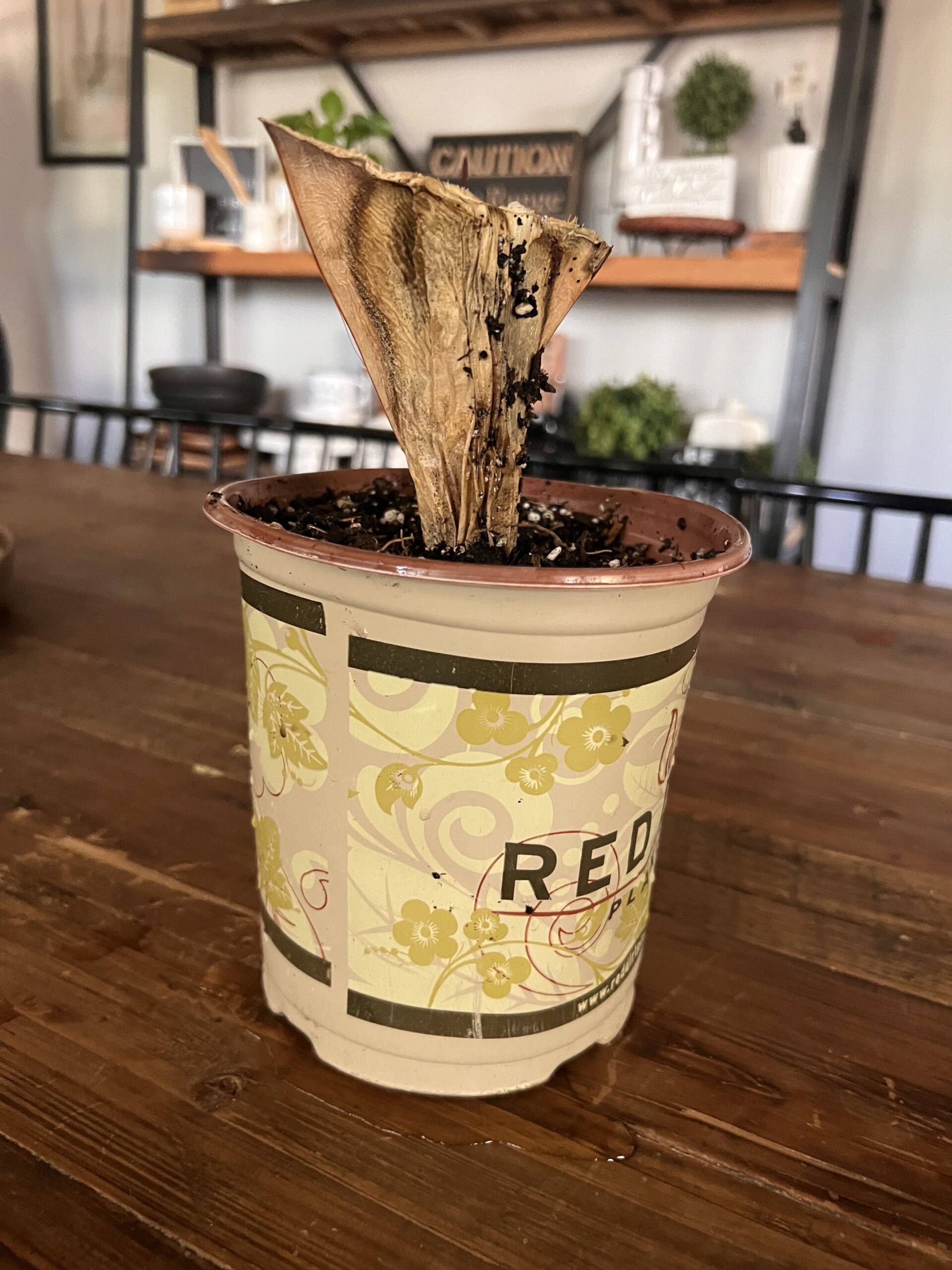
And that’s when I saw her—my welwitschia plant.
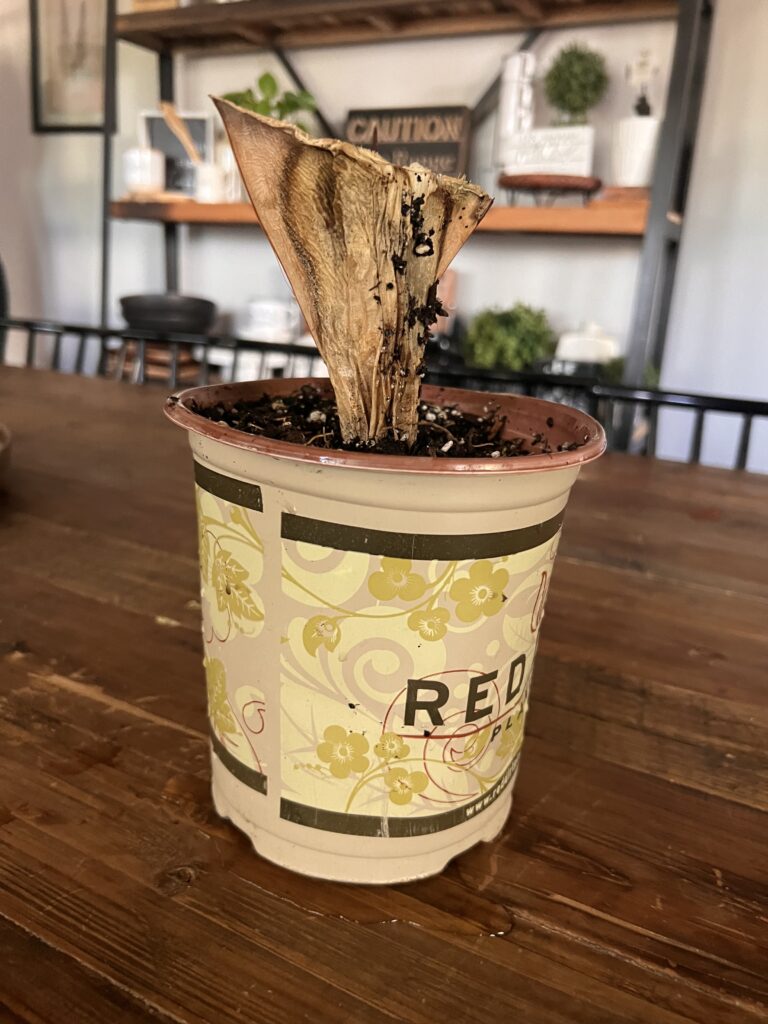
She was gone. Brown, wilted, scorched.
I’d paid $50 for her. Split her the year before. Watched both halves thrive.
Curious what kind of plant I’m talking about? It’s called a Whalefin plant—officially known as Dracaena masoniana. You can read more about it on Wikipedia, or check out a visual example from Costa Farms.
In January I noticed the fireplace had scorched her in some spots, so I cut off the parts that were dead, and left what I thought would survive and regrow. I had done this before and it worked.
But in April, I realized, it did not work this time.
And that was it. The last Jenga block. I walked over, grabbed her by the stem with my bare hand, yanked her from the pot, and threw her across the yard.
I wasn’t just mad at God. I was done. “So you’re taking my dad and my plant too?”
I know how ridiculous that sounds. But on days like that, everything feels like betrayal.
But then, in the middle of my tantrum… I saw it.
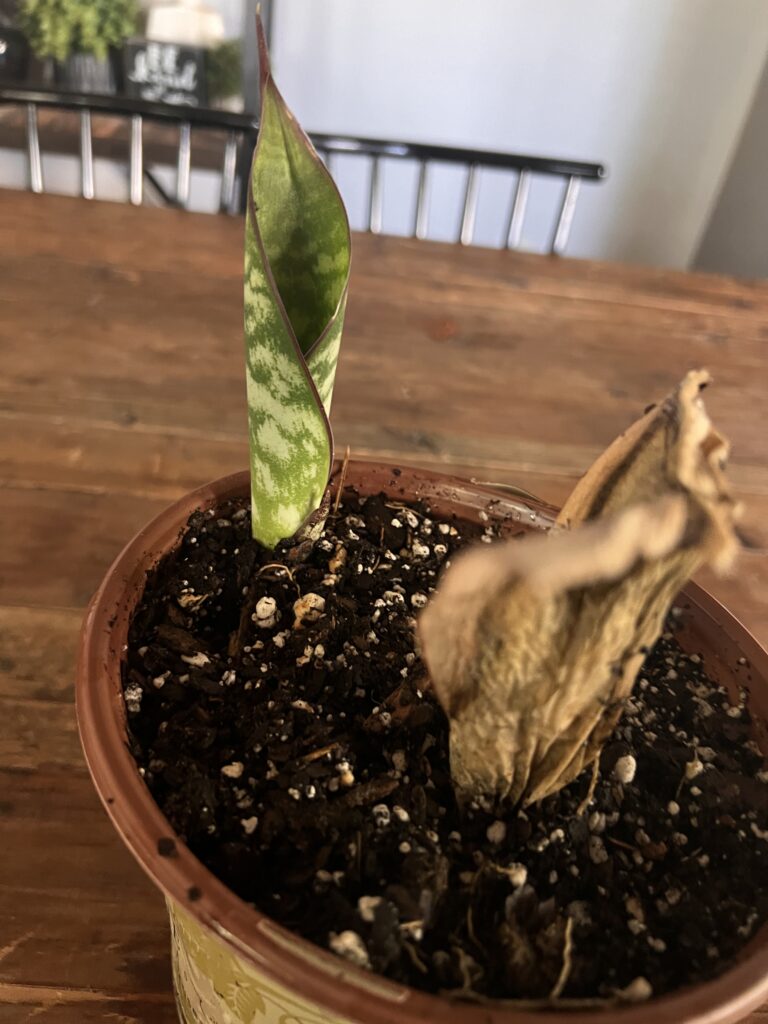
A baby shoot. Green. Alive. Growing quietly behind what I thought had died.
I froze. Because I realized—God had been working beneath the soil this whole time.
Even when it looked hopeless. Even when it looked dead. Even when I was yelling at the sky.
That new shoot? It didn’t just appear that day. It had been growing in the dark for months—while I was doubting, quitting, giving up.
And that’s when I surrendered. Not in shame. In awe.
I obviously ran back in the yard to grab the dead plant so I could show Robert what I was hearing from God. It was a moment of reckoning.
A month later, my dad’s next scan showed no evidence of disease. The doctor didn’t believe it. Said it was probably just “no new tumors.”
But three months after that, a second scan confirmed: my dad was cancer free.
The radiologist confirmed it with a call.
Right around the time that baby shoot showed up in my garden, he was already healing. And I hadn’t even known.
I’m not saying I have it all figured out. You don’t pull that far away from God without a long walk back.
But here’s what I am claiming:
That God shows up even if you don’t.
That sometimes your eyes lie.
That faith is not always felt first—but it’s never wasted.
They say “believe what you see and only half of what you hear.”
But now? I believe none of what I hear, only half of what I see— and all of what I know about God’s mercies.